/** Google Analytics script below */ /** end Google Analytics script */
Showing posts with label a stitch in time. Show all posts

Monday, November 14, 2011

A Stitch in Time: Reticello 1

Since I’m currently plodding away on lots of four-sided stitch on Ruskin Garden Square and don’t have much to share on that front, I hope you might be interested in one of my finished projects with a very similar type of needle lace.

Reticello 1 was designed by Diane Clements and was featured as the first of three reticello/reticella pieces in the (unfortunately now defunct) magazine The Needleworker in June/July 1999.

Reticello1_full

In this project, the edges of the center square were reinforced, then stitched all the way around with buttonhole stitch. The center square was then cut completely away. After basting the fabric to a laminated pattern, I added the horizontal, vertical, and diagonal lines, stitched over them, and then stitched the remaining shapes off of these lines. If I recall correctly, the project really wasn’t too difficult to stitch, but it took quite a while! The trickiest part was getting all of those triangles to have approximately the same tension so they came out the same size.

Reticello1_center

I did have great plans to stitch the remaining pieces in the series, as well as another project featured in the Winter 2001 Fine Lines from the same designer. It just hasn’t happened yet! Smile

Have you tried any reticella work? How did it turn out? We’d love to see pictures!

Friday, July 30, 2010

Friday Finish: Jacqui's Choice

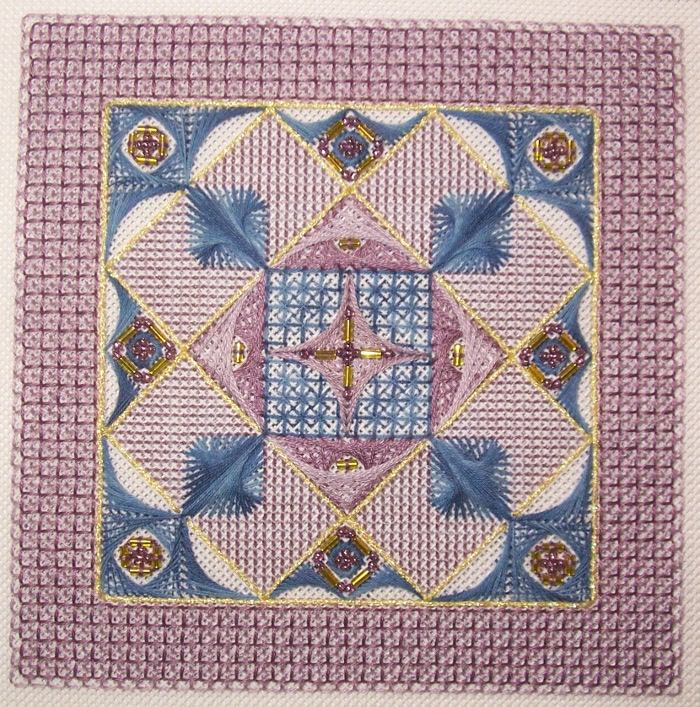
Since I'm back on a canvaswork kick, here's one of my early canvas projects.

Design: Jacqui's Choice

Designer: Nanette Costa

Technique: counted canvas

Ground fabric: 18ct mono canvas

Threads: cotton floss, metallic threads, seed and pearl beads

Stitches used: couching, beading, lots of Hilton stitches (jessicas, crescents, Amadeus)

Stitching timeframe: 2002-2003

This project was from my very first multiple-day class, taken with my local EGA chapter. Up until this, I had only taken classes through my local shop or 1 day classes at a stitching festival. Needless to say, I really enjoyed it.

I actually had it framed on point. Looking at it now, I like the diamond shape, but I’m not crazy about the rest of the framing choices, though I’m not sure what I would change if I were to have it reframed.

I’ve wondered whatever happened to Nanette Costa. She was a fabulous teacher. I’m saddened to find her listed on the “inactive or retired” list on the National Academy of Needlearts (NAN) website. Does anybody know what she’s up to now that she’s not teaching?

There are still a few of her commercial patterns in various online shops if you look hard enough.

Friday, July 16, 2010

Friday Finish: Silk Pageantry

This week's pick is just because I haven't featured much canvaswork lately here on Just String.

Design: Silk Pageantry, a now-retired ANG group correspondence course

Designer: Kay Cline

Technique: silk and metal on canvas

Ground fabric: 18ct mono canvas

Threads: silk floss, metallic threads, silver pearl purl

Stitches used: crossed and flat canvaswork stitches, couching

Stitching timeframe: middle to late 2006

I changed all but the background colors from Kay Cline's original design, including switching from gold pearl purl to silver. I was surprised to notice that the silver is starting to tarnish a bit already. Does anybody have any hints for slowing this tarnishing?

You may not be able to tell from the picture, but the pearl purl (see the arrows in the picture) is actually slightly stretched from its original form, resulting in a wavy silver wire that is couched. I really like this technique.

In case you're curious about how I framed this:

Friday, July 9, 2010

Friday Finish: My first Hardanger

In the spirit of the Hardanger piece I'm working on now, I present the very first Hardanger design I ever stitched.

Design: a runner made from doubling the bellpull design from Cross 'N Patch's Charity Sampler booklet

Designer: Emie Bishop

Technique: Hardanger and cross stitch

Ground fabric: 32ct evenweave (jobelan, maybe?)

Threads: pearl cotton and floss

Stitches used: cross stitch, kloster blocks, buttonhole, lacy edge, bullions, dove's eyes, spider webs, other filling stitches

Stitching timeframe: Finished in 1996. I'm guessing I worked on and off on this for a year, given that I was in college at the time.

This was my first Hardanger piece, as I mentioned above. It is a prime example of the attitude of "It's just string." Or it could have been simple ignorance. Take your pick.

  • I didn’t think it was a big deal to essentially stitch the bellpull (which consisted of two of the diamond repeats and the heart at the bottom) twice.
  • I didn't know lacy edge and bullions were supposed to be difficult.
  • I do recall vigilantly checking the alignment of my kloster blocks before cutting any threads, but I don't really remember any anxiety about cutting the threads once I knew everything lined up.

In hindsight, it’s easy to see that I should have practiced bullion knots on a doodle cloth before putting them on the real piece. In this picture, you can see the little squares made up of bullion knots on the right, where I started, and those on the left, where I finished after going all the way around the piece. There is a very distinct difference in tension!

I don’t really recall having much difficulty with the lacy edge, but to this day, I haven’t used this stitch on any other piece.

Here’s a close up of one of the ends of the design.

I should find a place to display this rather than keeping it in my cedar chest. Maybe a high shelf where little fingers can’t reach.

Friday, July 2, 2010

Friday Finish: Casalguidi and Lavender

Only I would propose a new series of going through past (and some current) finishes, post only two weeks on that series, and then neglect it for another two weeks. There’s no excuse, but here’s my attempt to resurrect the plan.

Here’s one that’s been done for quite a while.

Design: Casalguidi and Lavender (a retired EGA correspondence course)

Designer: Barbara Kershaw

Technique: Casalguidi (of course!)

Ground fabric: 28(?) ct linen

Threads: pearl cotton

Stitches used: Casalguidi stitch, italian four sided, detached buttonhole, needleweaving, and some neat wrapped stitch that looks like a REALLY long bullion knot (but I didn’t look up what it’s called)

Stitching timeframe: I don’t know. Finished sometime in 2006, I think.

Casalguidi is often stitched white on white or ecru on ecru, but the book Casalguidi Style Linen Embroidery by Effie Mitrofanis (now MUCH more expensive than when I purchased it) shows some antique pieces that are white or ecru on pink or light blue. These inspired me to use some pinkish linen in my stash with ecru threads.

Does the stitch used in the heavy diagonal bar in the middle of the piece look familiar? It’s the Casalguidi stitch, which I used as Santa’s walking stick on Celebration Santa.

Tuesday, December 25, 2007

A Very Merry Christmas to You!

Merry Christmas, everyone! I hope Santa has been good to you!

I have stitched several Christmas pieces over the years, but it seems that for the most part, they either haven't been framed or have been given away. The only one I have framed in my home is the canvaswork nativity seen here. This is Once In Royal David's City by Carole Lake. I took it as an online class, but Carole has now released it for a wider audience: the instructions were in the most recent issue of Needlepoint Now.

May you all have a happy, healthy, and blessed Christmas!

Saturday, May 5, 2007

A Stitch in Time: Lilacs on gauze

Yesterday, I mentioned that I'll be starting a silk gauze piece on Monday. This will not be my first gauze project from a chart by Gitta's.

A few years ago, my job required that I make a trip to Toronto (Mississauga, actually) once a month or so. This is a fairly easy car trip of about 3 hours from my home. On only one trip did I have time to visit a few needlework shops in the area, and one of those I visited was Gitta's. I fell in love with several of their floral pieces, and though the shop models were on canvas, I thought they would be stunning on gauze. Naturally, I picked up a few charts!

I have so far only stitched one of these charts, with Eterna silks (as I explained yesterday). I couldn't be more pleased with the finished piece, Lilacs. It's difficult to tell by the picture, but the stitching measures only about 2" wide and 4" tall. I chose this as the first of the charts to stitch because in my area, lilacs bloom for my birthday, and our city has an annual Lilac Festival with hundreds of the bushes in bloom at a local park. The sight of these always makes me smile!

Apparently I'm not the only person who likes the finished piece! I'm proud to say that this piece won People's Choice both at the last judged show held by my EGA chapter and at the showcase at Hershey CATS in 2002.

Tuesday, April 3, 2007

A Stitch in Time: Toccata Number Two

One of my favorite designers of modern samplers is Cynthia Zittel of The Drawn Thread. This is her Toccata Number Two. According to Wikipedia, the term "toccata" means "to touch" and is typically used to describe a musical composition that is designed to "emphasiz[e] the dexterity of the performer". If that's what Ms. Zittel had in mind for this piece, she did a wonderful job!

I finished this in 2005, and had a wonderful time with it! Some of the motifs were simply cross stitch, but many introduced new techniques and new stitches to educate and stretch the stitcher's experience.

It was in this piece that I used Japan gold thread for the first time - in multiple sizes. (More on Japan gold in a later post!) The larger sizes were couched down for various techniques, including an introduction to a goldwork technique called Or Nue (pronounced "or nu-way"). In this technique, the couching stitches make a pattern over a background of gold threads. Typically in or nue, the couching stitches are simply straight stitches perpendicular to the laid background, but in Toccata 2, crosses are used to couch a pattern, as seen in the picture on the right.

This piece had many other fun bits to keep my interest, as well. Like the gold and perle pulled work "sampler in a sampler":

And a cute potted flower with satin stitch petals and queen stitch leaves (I used to hate queen stitches until Eileen Bennett showed me her method!):


And a wonderful little dragonfly with wings of perle couched with the smallest size of Japan gold:


And then there's the peacock, and the topiary, and the entire alphabet of letters in different styles and sizes, and the row at the very bottom with seven different little flowers, and...

Needless to say, I had a blast with this piece!

Now, the particulars: I stitched this completely from my stash, matching silks of different brands to the DMC numbers listed. From what I can remember, I used Au ver a Soie's Soie d'Alger, Amy Mitten's Fibers to Dye For, and Rainbow Gallery's Splendor. I used a fat quarter of 36 ct Lakeside linen in Light Vintage Exemplar from Silkweaver's fabric of the month club (when they carried Lakeside!). It was fun to shop in my stash for just the right colors!

Sunday, March 25, 2007

A Stitch in Time: Monrovia

Since I've been stitching for over 15 years, and blogging only one week, there are plenty of past projects to share when other topics don't present themselves. I've pondered for a while about what to call these posts: Back-stitch? Project Flashback? Masterpiece Theatre? (LOL!) I've finally settled on "A Stitch in Time", but I'm open to more creative options, if anybody has a suggestion. This might become a regular feature of this blog. Please let me know if you like it or not!

Anyway, this "stitch in time" post features a piece I finished earlier this year. It is Monrovia, the fourth ornament in Jim Wurth's Dodecagon series. This is a counted canvaswork project, stitched on white 18ct mono canvas, with silk, metallic, rayon, and nylon threads, and glass beads.

If you're curious about counted canvaswork, also known as counted needlepoint, Rainbow Gallery has a very extensive collection of freebie charts. Looking at some of these charts can give you a feel for how these directions are typically presented. This technique is where counted thread work meets canvas, usually considered the domain of hand-painted needlepoint. It's a good bridge between the two styles.